BREAD – A MOTIVE OF THE ART PROGRAM OF ORTHODOX CHURCHES
Gallery “Prometej”, Novi Sad
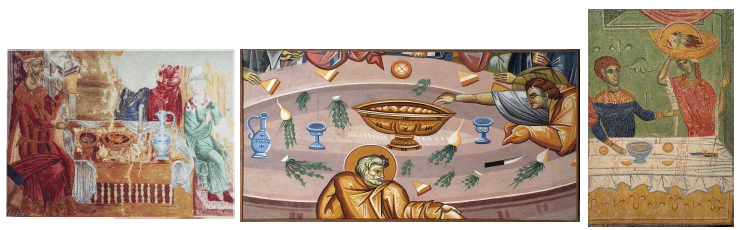
A unique exhibition that thematically deals with the symbolism of bread in medieval frescoes of Serbian monasteries. The exhibition was opened by Mr. Dušan Petrović, rector of the Karlovac Theological Seminary
If, introducing the viewer to the topic presented by this exhibition, we look back at the period when Christianity fought, conditionally speaking, for its “place under the sun”, we cannot ignore the fact that some of the key events related to personalities originating from the area that includes today’s Serbia. The Roman emperor Galerius came from the vicinity of Zaječar, i.e. Gamzigrad, who was the first, with the Edict on tolerance of the Christian faith in 311 AD, to open the way for this religion, while Emperor Constantine, also a native of these regions (Naissus – Niš), would soon declare it the state religion, with the Edict of Milan in 313 AD. Since then, Christians, freely building their temples, began to form more precise artistic programs, interpreting the written word of the Bible with pictures. Bread is found in different scenes in that program. However, its most significant form is the liturgical one, which, along with wine, represents a tangible part of the deification of man. During communion, believers become part of the holy Mystery of Mysteries.
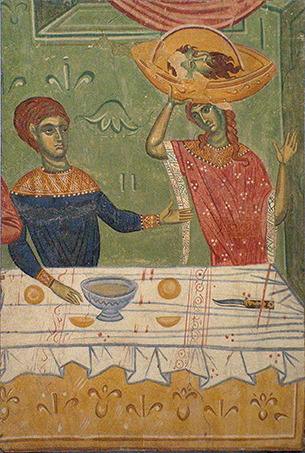
Taking the naphora (Gr. anaphero – I lift up), they receive a part of Christ’s body. This happens during the Holy Liturgy (Eucharist or Eucharist), i.e. its final act, when the choir sings “Receive the Body of Christ…”. Because, the Eucharist was instituted by Christ himself at the Last Supper, when, giving bread and wine to the apostles, he said, “With bread, eat; this is my body” (Matthew, 108; 26), “Drink from it (cups), all of you; For this is my blood” (Matthew, 108; 27, 28). Therefore, the first communion was performed by Christ himself, giving bread and wine to the apostles, and further, it is transmitted to believers “for ever and ever”. By leaving the church after communion, it is considered that the believer brings out a part of Christ in him “calling to make the whole world the House of Bread”. The holy liturgical bread is the most important, but this exhibition contains many other scenes where it becomes part of the story, always in some way connected with the Holy Mystery. After Herod’s feast, for example, and the execution of John the Baptist, Salome dances with his head on a plate in front of a table with bread on it. A little later, (Matthew, 58; 16 – 21) the Miracle of Christ happens, when he succeeds, multiplying them, to feed a multitude of people with five loaves of bread and two fish. “And those who ate were about five thousand people, except for women and children,” writes the Evangelist Matthew. Scenes such as the Wedding at Cana, Abraham’s Hospitality, The Story of the King’s Feast and others also feature bread…
And in the basic prayer “Our Father”, which the believers say every day, bread is not left out: “Give us this day our daily bread…”. Copies of frescoes from monasteries that can be found today in Serbia and in nearby regions and countries illuminate the bread, as a motif on the frescoes, from different angles. And each of us, by plunging into the essence and significance of bread, will be able to discover the multi-layered and metaphorical nature of this topic as much as I explore its depths.
Spomenka Jelić, art historian